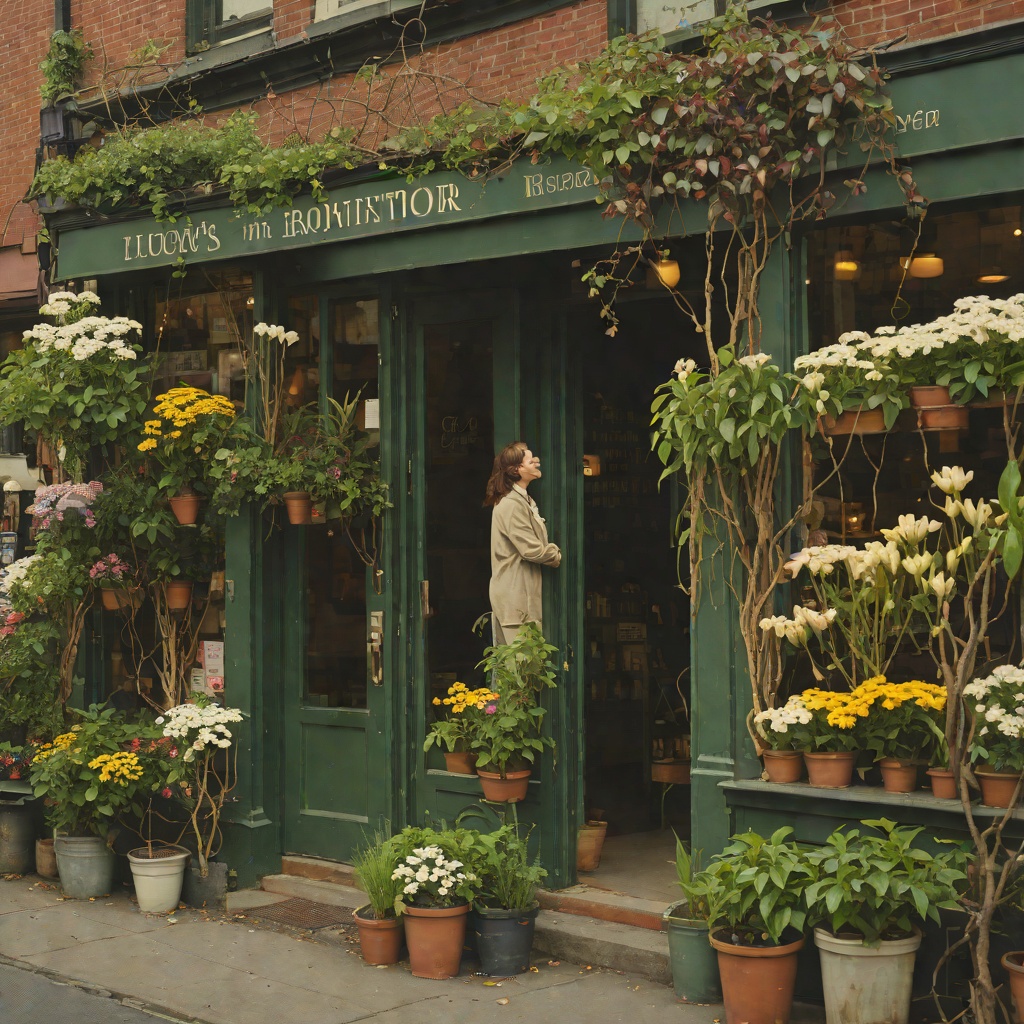
Lily Bloom's
It Ends with UsLily Bloom's is the floral shop that Lily Bloom opens in Boston, a personal dream realized that becomes the stage for her reunion with Ryle Kincaid and, later, a symbol of her independence and the life she builds on her own terms. More than a business, the shop is the first concrete proof of Lily's ambition and self-reliance, the place where she first tells Ryle her name, and the anchor of a new life that she builds in a city she once associated only with escape. Its story tracks her arc from hopeful entrepreneur to established businesswoman, and its walls quietly witness the novel's central relationships taking shape.
Identity and Foundation
Lily Bloom's is a floral shop that Lily opens in Boston, and it is the fulfillment of a long-held personal ambition. When she first describes the venture to Ryle Kincaid, she calls it "Lily Bloom's" and explains that it will be a floral shop in about two months' time. The name itself is a declaration: the shop carries her own name, making her identity as its founder inseparable from the business itself. She tells Ryle that she decided to try it while she is still young enough to bounce back from failure, a remark that reveals both her determination and her awareness of the risk she is taking. The shop is not inherited, not funded by a partner, and not a compromise; it is entirely her own project, and its creation marks the beginning of her independent adult life in Boston.
Opening and Early Days
The shop opens with a soft opening rather than a grand launch, a deliberate choice to work out any kinks before a full marketing push. On that first day, Lily and her friend Allysa Kincaid flip the sign to Open and hug and squeal like little kids, treating the modest occasion as if it were the best thing that had ever happened to them. They rush around the counter to wait for their first customer, though they are not even sure anyone will come. Lily's mother and Marshall are expected to visit later that day, which Lily counts as two customers for sure, and she declares that plenty. The scene captures the shop's humble beginnings and the joy Lily takes in the work itself, independent of commercial success. She looks around the space bursting with pride, reflecting that she had a dream and busted her ass to make it come true, and that whatever happens after today is just icing on the cake. The shop's early atmosphere is one of hope and simple satisfaction, a stark contrast to the turbulence that will later enter her life.
Recognition and Growth
Lily Bloom's earns public recognition when it is nominated for a Best of Boston award, a people's choice award that the newspaper holds annually. The nomination comes under the "Best new businesses in Boston" category, which is reserved for businesses that have been open less than two years. Lily learns of the nomination when Ryle shows her a newspaper article, and she initially tries not to get her hopes up, suspecting he might be talking about something entirely different. When she reads the headline, "Best new businesses in Boston. Votes are in for your top ten!," she realizes he is talking about exactly what she was thinking. The nomination is not entirely unexpected: a reporter for the paper had called her the previous week and asked her a series of questions, which had given her a suspicion she might have been chosen. The recognition marks the shop's transition from a personal dream to a publicly validated business, and it is one of the few moments in the novel where Lily's professional life brings her uncomplicated pride.
The Shop as a Setting for Relationships
The shop serves as the backdrop for several pivotal moments in Lily's relationships. It is at Lily Bloom's that she first tells Ryle her name and reveals her plan to open the shop, and it is there that their connection begins to take root. The shop also becomes a point of connection with Allysa, who helps Lily on opening day and shares in her excitement. Later, the shop's success and Lily's life in Boston become entangled with the larger story of her marriage and its unraveling. When Lily flees Ryle after his assault, she reflects that she cannot go to a hotel because Ryle could track the credit card charge and find her, and that he would be able to find her at her mother's, at Allysa's, at Lucy's, or even at Devin's. The shop, by contrast, is not a place she runs to for shelter; it is the place she built for herself, and its existence is part of the independent life that Ryle's violence threatens. The shop thus stands as a symbol of the life Lily has created on her own, a life she is determined to protect.
Symbolic Significance and Legacy
Beyond its practical role, Lily Bloom's carries deep symbolic weight in the novel. It represents Lily's agency and her refusal to be defined by the men in her life, whether her abusive father, her violent husband, or even the first love she never forgot. The shop is her own creation, and its success is her own. In the novel's final movement, Lily's determination to break the cycle of abuse for her daughter Emerson is framed in terms that echo the independence the shop represents. She reflects that cycles exist because they are excruciating to break, and that it takes an astronomical amount of pain and courage to disrupt a familiar pattern. She promises her daughter, "It stops here. With me and you. It ends with us." The shop, as the foundation of her independent life, is part of what makes that promise possible. It is the concrete evidence that Lily can build something lasting on her own, and it stands as a quiet counterpoint to the relationships that threaten to consume her. In the epilogue, when Lily reunites with Atlas Corrigan on Boylston Street and he whispers that she can stop swimming now because they finally reached the shore, the life she has built—including the shop—is the shore she has reached.